Adding and subtracting fractions with unlike denominators
7 min read · 10 sections
Add 1/2 and 1/3 by adding the tops and the bottoms and you get 2/5, a number smaller than the 1/2 you started with. That alone should stop you. Adding fractions with unlike denominators means cutting both into pieces of the same size first, and the rest is bookkeeping you can do cheaply and without slips.
I mark a lot of fraction homework and I cut a lot of boards, and the same three habits separate clean work from messy work: find the LCD before you touch a numerator, write the multipliers down, and reduce only at the end. Everything below builds on those.
Why you cannot add the bottoms
The denominator names the size of the piece and the numerator counts how many pieces you have. Halves and thirds are different sizes, so 1 half plus 1 third is not "2 of something". You have to rename both in a size they share. Sixths work: a half is 3 sixths, a third is 2 sixths, together 5 sixths.
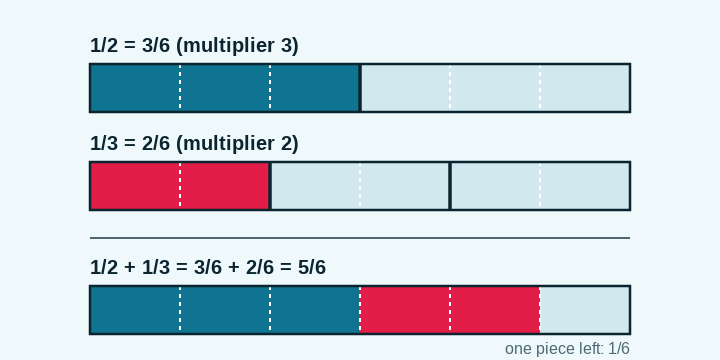
Renaming never changes the amount. Multiplying top and bottom by the same number multiplies by 1, so 1/2 = 3/6 and 1/3 = 2/6 are the same quantities in a new size.
Find the LCD, two ways
The least common denominator (LCD) is the smallest number that both denominators divide into. You can list multiples or use prime factors.
- List multiples. For 12 and 18: multiples of 12 are 12, 24, 36; multiples of 18 are 18, 36. The first match is 36.
- Prime factors. 12 = 2 × 2 × 3 and 18 = 2 × 3 × 3. Take each prime the greatest number of times it appears in either: two 2s and two 3s, so 2 × 2 × 3 × 3 = 36.
Listing is fine for small numbers. Factors win when the denominators get awkward, and they are what a fraction calculator does internally with the greatest common factor: LCD = (a × b) ÷ GCF(a, b), here 12 × 18 ÷ 6 = 36.
The six moves, with 7/12 − 5/18
- Find the LCD of 12 and 18: 36.
- Work out each multiplier, LCD ÷ denominator: 36 ÷ 12 = 3 and 36 ÷ 18 = 2.
- Rename both fractions: 7/12 = (7 × 3)/(12 × 3) = 21/36 and 5/18 = (5 × 2)/(18 × 2) = 10/36.
- Subtract the tops and keep the bottom: 21/36 − 10/36 = 11/36.
- Reduce: GCF(11, 36) = 1, so it is already in lowest terms.
- Check with decimals: 7/12 ≈ 0.5833 and 5/18 ≈ 0.2778, difference ≈ 0.3056, and 11/36 ≈ 0.3056.
Writing the multipliers beside the fractions, "(×3)" and "(×2)", is the single habit that catches most slips. The LCD also keeps numbers small; a later section shows what happens when you skip it.
Three or more fractions
With 1/4 + 1/6 + 1/8, find one LCD for all three denominators at once. Multiples of 8 run 8, 16, 24; 24 is divisible by 4 and by 6 as well, so the LCD is 24. Do not combine in pairs and then hunt for a second LCD; one common size for the whole line is shorter and safer.
| Fraction | Multiplier (24 ÷ denominator) | Renamed |
|---|---|---|
| 1/4 | 6 | 6/24 |
| 1/6 | 4 | 4/24 |
| 1/8 | 3 | 3/24 |
| Sum | 13/24 (6 + 4 + 3 = 13, and 13 shares no factor with 24) |
The shortcut with the product of the denominators
Many sites teach a/b + c/d = (ad + bc)/bd. It always works, and calculator.net lists it as the standard formula. The price is bigger numbers, and you must reduce at the end.
Take 7/12 − 5/18 again. The product of the denominators is 12 × 18 = 216. Then 7 × 18 = 126 and 5 × 12 = 60, so the result is (126 − 60)/216 = 66/216. Divide top and bottom by their GCF, 6, and you land on 11/36, the same answer as before. Forget to reduce and 66/216 is marked wrong, even though it equals 11/36.
My rule: use the shortcut when the denominators share no factor (2 and 3, or 5 and 8), because then the product already is the LCD. Use the LCD when they do share one (12 and 18, 6 and 8, 4 and 16).
Mixed numbers: two routes
Take 2 1/3 + 1 3/4.
- Improper route. 2 1/3 = 7/3 and 1 3/4 = 7/4. LCD 12: 28/12 + 21/12 = 49/12 = 4 1/12.
- Whole and parts route. Add the wholes, 2 + 1 = 3, and the fractions, 1/3 + 3/4 = 4/12 + 9/12 = 13/12 = 1 1/12. Then 3 + 1 1/12 = 4 1/12.
Both give 4 1/12. The improper route is the one that never fails, especially with negatives and with subtraction. The parts route is quicker for addition when the fractions are small, but the fraction sum can top 1 (here 13/12) and you have to carry it into the wholes.
Borrowing when you subtract mixed numbers
If the fraction you take away is bigger than the one you take it from, borrow one whole from the whole-number part and write that whole as LCD/LCD. Start with 4 1/2 − 2 3/4:
- Rename to quarters: 4 2/4 − 2 3/4. You cannot take 3/4 from 2/4.
- Borrow 1 from the 4, written as 4/4: 3 and (2/4 + 4/4) = 3 6/4.
- Subtract the parts: 3 − 2 = 1 and 6/4 − 3/4 = 3/4.
- Answer: 1 3/4.
A harder one, 3 1/4 − 1 5/6, uses the LCD 12. Rename: 3 3/12 − 1 10/12. Borrow: 2 15/12 − 1 10/12. Subtract: 1 5/12. The improper route confirms it: 13/4 − 11/6 = 39/12 − 22/12 = 17/12 = 1 5/12.
When I want to be certain, I do both routes and compare. If they disagree, one has a renaming slip, almost always a multiplier applied to the top but not the bottom.
Negative fractions and mixed numbers
In −2 3/4 the minus belongs to the whole number, 2 3/4, not just to the 2. So −2 3/4 = −(2 + 3/4) = −11/4, which is not −2 + 3/4. The Common Core standards put it neatly: −(p/q) = (−p)/q = p/(−q), so the sign may sit in front, on top or below, and the value is the same (see grade 7, 7.NS).
Example: −2 3/4 + 3 5/7 = −11/4 + 26/7. LCD 28: −77/28 + 104/28 = 27/28. A line like that is easy to mistype by hand, which is why I like a fraction calculator that reads the whole expression and shows each conversion.
On the tape measure
Measurements are fraction addition in disguise. Join 5 3/8" and 2 11/16". Here 5 3/8 = 43/8 = 86/16 and 2 11/16 = 43/16, so the total is 129/16 = 8 1/16". The LCD is the finer mark on the tape, here sixteenths.
A shelf job shows how it chains. A 96" board gives three shelves of 23 5/8", and each saw cut eats 1/8". Material used: 3 × 23 5/8 = 70 7/8 and 3 × 1/8 = 3/8, total 71 1/4. Left over: 96 − 71 1/4 = 24 3/4". For turning decimal readings into those marks, see the fraction to decimal chart.
Checklist before you write the answer
- Denominators are different, so find the LCD of all of them, not just two.
- Each multiplier is LCD ÷ denominator and was applied to top and bottom.
- Only the numerators were added or subtracted; the denominator stayed put.
- In mixed-number subtraction, the borrowed 1 was written as LCD/LCD.
- The result is reduced by the GCF and written as a mixed number if the question asks for one.
- A decimal check agrees to a few places.
Multiplying and dividing need no common denominator at all; that is the topic of the guide on dividing fractions with keep-change-flip. For the grade-level wording of what students are expected to do here, see Common Core 5.NF.
Common questions
How do you add fractions with different denominators?
Find the least common denominator, rename each fraction to that denominator by multiplying top and bottom by LCD divided by its denominator, add the numerators, keep the denominator and reduce. Example: 1/2 + 1/3 = 3/6 + 2/6 = 5/6.
Do I have to use the least common denominator?
No. Any common denominator works, for instance the product of the denominators, but the answer must then be reduced. For 7/12 − 5/18 the product 216 gives 66/216, which reduces to 11/36, the answer the LCD 36 gives directly.
How do you subtract mixed numbers when the second fraction is bigger?
Borrow 1 from the whole number and write it as LCD/LCD, then add it to the first fraction. 4 1/2 − 2 3/4 becomes 4 2/4 − 2 3/4 = 3 6/4 − 2 3/4 = 1 3/4.
How do you add three fractions?
Find one LCD for all three denominators, rename all three, add the three numerators and reduce. 1/4 + 1/6 + 1/8 uses the LCD 24 and equals 6/24 + 4/24 + 3/24 = 13/24.
Where does the minus sign go in a negative mixed number?
The minus applies to the whole number, so −2 3/4 means −(2 + 3/4) = −11/4. Writing it as −2 + 3/4 would give −5/4, which is a different number.