Fraction to decimal chart: halves to sixty-fourths
7 min read · 8 sections
Need 5/8 as a decimal, or 0.6875 as a tape-measure mark? A fraction to decimal chart gives you both at a glance. The charts below run from halves to sixty-fourths, with every repeating decimal marked, and the sections after them show how to get any value the charts leave out.
I keep a chart like this taped inside a cabinet door in the shop, and I hand the repeating half of it to students who think a calculator's 0.3333333 is the real answer. Both readers want the same thing: a number they can trust, and the reason it looks the way it does.
How to read the charts
A decimal in parentheses repeats forever: 0.41(6) means 0.41666…, and 0.(142857) means 0.142857142857…. Percent is the decimal times 100, rounded to two places where the decimal repeats. Every fraction is in lowest terms, so 2/4 and 4/8 are not listed; they are 1/2.
Fractions that end
| Fraction | Decimal | Percent |
|---|---|---|
| 1/2 | 0.5 | 50% |
| 1/4 | 0.25 | 25% |
| 3/4 | 0.75 | 75% |
| 1/5 | 0.2 | 20% |
| 2/5 | 0.4 | 40% |
| 3/5 | 0.6 | 60% |
| 4/5 | 0.8 | 80% |
| 1/8 | 0.125 | 12.50% |
| 3/8 | 0.375 | 37.50% |
| 5/8 | 0.625 | 62.50% |
| 7/8 | 0.875 | 87.50% |
| 1/10 | 0.1 | 10% |
| 3/10 | 0.3 | 30% |
| 7/10 | 0.7 | 70% |
| 9/10 | 0.9 | 90% |
| 1/16 | 0.0625 | 6.25% |
| 3/16 | 0.1875 | 18.75% |
| 5/16 | 0.3125 | 31.25% |
| 7/16 | 0.4375 | 43.75% |
| 9/16 | 0.5625 | 56.25% |
| 11/16 | 0.6875 | 68.75% |
| 13/16 | 0.8125 | 81.25% |
| 15/16 | 0.9375 | 93.75% |
Fractions that repeat
| Fraction | Decimal | Percent (2 places) |
|---|---|---|
| 1/3 | 0.(3) | 33.33% |
| 2/3 | 0.(6) | 66.67% |
| 1/6 | 0.1(6) | 16.67% |
| 5/6 | 0.8(3) | 83.33% |
| 1/7 | 0.(142857) | 14.29% |
| 2/7 | 0.(285714) | 28.57% |
| 3/7 | 0.(428571) | 42.86% |
| 4/7 | 0.(571428) | 57.14% |
| 5/7 | 0.(714285) | 71.43% |
| 6/7 | 0.(857142) | 85.71% |
| 1/9 | 0.(1) | 11.11% |
| 2/9 | 0.(2) | 22.22% |
| 4/9 | 0.(4) | 44.44% |
| 5/9 | 0.(5) | 55.56% |
| 7/9 | 0.(7) | 77.78% |
| 8/9 | 0.(8) | 88.89% |
| 1/11 | 0.(09) | 9.09% |
| 2/11 | 0.(18) | 18.18% |
| 3/11 | 0.(27) | 27.27% |
| 4/11 | 0.(36) | 36.36% |
| 5/11 | 0.(45) | 45.45% |
| 6/11 | 0.(54) | 54.55% |
| 7/11 | 0.(63) | 63.64% |
| 8/11 | 0.(72) | 72.73% |
| 9/11 | 0.(81) | 81.82% |
| 10/11 | 0.(90) | 90.91% |
| 1/12 | 0.08(3) | 8.33% |
| 5/12 | 0.41(6) | 41.67% |
| 7/12 | 0.58(3) | 58.33% |
| 11/12 | 0.91(6) | 91.67% |
Round with care. 1/3 as 0.3333 is a rounded value, not the number; on a long calculation the rounding error grows. Keep the fraction as long as you can and convert at the end.
Long division, and how to spot the repeat
A fraction is a division: 5/12 means 5 ÷ 12. Divide, bring down a zero, and keep every remainder.
- 50 ÷ 12 = 4, remainder 2. First digit 4, so 0.4.
- 20 ÷ 12 = 1, remainder 8. Next digit 1, so 0.41.
- 80 ÷ 12 = 6, remainder 8. Digit 6, and the remainder 8 has appeared before.
The moment a remainder repeats, every later step repeats too, so the digits cycle: 5/12 = 0.41(6). There are only d − 1 possible non-zero remainders, so the repeating block is never longer than d − 1 digits. 1/7 is the extreme case: remainders 1, 3, 2, 6, 4, 5 and back to 1, giving the full six-digit block 0.(142857). Grade 7 states the rule plainly: the decimal of a fraction either terminates or eventually repeats (7.NS.A.2d).
Which fractions end?
Reduce the fraction first. It terminates exactly when the denominator has no prime factors other than 2 and 5, because those are the factors of 10.
| Fraction | Denominator factors | Result |
|---|---|---|
| 3/8 | 2 × 2 × 2 | ends: 0.375 |
| 7/10 | 2 × 5 | ends: 0.7 |
| 5/12 | 2 × 2 × 3 | repeats: 0.41(6) |
| 3/9, reduced to 1/3 | 3 | repeats: 0.(3) |
| 6/15, reduced to 2/5 | 5 | ends: 0.4 |
The last two rows show why you reduce first. 6/15 looks as if it should repeat because of the 3 in 15, but the 3 cancels.
Decimals back to fractions
For a decimal that ends, put the digits over a power of ten and reduce: 0.375 = 375/1000 = 3/8, and 0.6875 = 6875/10000 = 11/16. The method is the one on Math is Fun. Count the decimal places, and that many zeros go in the denominator.
A repeating decimal takes one extra move: shift the point by the block length and subtract, so the endless tail cancels. For 0.1(6), call it x. Then 100x = 16.666… and 10x = 1.666…. Subtract: 90x = 15, so x = 15/90 = 1/6. For 1.2(36), 1000x = 1236.3636… and 10x = 12.3636…, so 990x = 1224 and x = 1224/990 = 68/55.
| Decimal | Fraction |
|---|---|
| 0.(3) | 1/3 |
| 0.1(6) | 1/6 |
| 0.(142857) | 1/7 |
| 1.2(36) | 68/55 |
| 0.(9) | 1 |
| 0.41(6) | 5/12 |
Yes, 0.(9) equals 1. Take x = 0.999…, then 10x − x = 9, so x = 1. And mind the difference between 0.333 and 0.333…: the first is 333/1000, the second is 1/3, and they differ by 1/3000. If you meant the repeating one, mark the repeat.
Decimal inches and the 1/64 chart
This is the chart for the shop. One inch is exactly 25.4 mm, so the millimetre column is exact. Bold rows are the sixteenth marks, the ones most tape measures label.
0 to 1/4 inch
| Fraction of an inch | Decimal inches | Millimetres |
|---|---|---|
| 1/64 | 0.015625 | 0.396875 |
| 1/32 | 0.03125 | 0.79375 |
| 3/64 | 0.046875 | 1.190625 |
| 1/16 | 0.0625 | 1.5875 |
| 5/64 | 0.078125 | 1.984375 |
| 3/32 | 0.09375 | 2.38125 |
| 7/64 | 0.109375 | 2.778125 |
| 1/8 | 0.125 | 3.175 |
| 9/64 | 0.140625 | 3.571875 |
| 5/32 | 0.15625 | 3.96875 |
| 11/64 | 0.171875 | 4.365625 |
| 3/16 | 0.1875 | 4.7625 |
| 13/64 | 0.203125 | 5.159375 |
| 7/32 | 0.21875 | 5.55625 |
| 15/64 | 0.234375 | 5.953125 |
| 1/4 | 0.25 | 6.35 |
1/4 to 1/2 inch
| Fraction of an inch | Decimal inches | Millimetres |
|---|---|---|
| 17/64 | 0.265625 | 6.746875 |
| 9/32 | 0.28125 | 7.14375 |
| 19/64 | 0.296875 | 7.540625 |
| 5/16 | 0.3125 | 7.9375 |
| 21/64 | 0.328125 | 8.334375 |
| 11/32 | 0.34375 | 8.73125 |
| 23/64 | 0.359375 | 9.128125 |
| 3/8 | 0.375 | 9.525 |
| 25/64 | 0.390625 | 9.921875 |
| 13/32 | 0.40625 | 10.31875 |
| 27/64 | 0.421875 | 10.715625 |
| 7/16 | 0.4375 | 11.1125 |
| 29/64 | 0.453125 | 11.509375 |
| 15/32 | 0.46875 | 11.90625 |
| 31/64 | 0.484375 | 12.303125 |
| 1/2 | 0.5 | 12.7 |
1/2 to 3/4 inch
| Fraction of an inch | Decimal inches | Millimetres |
|---|---|---|
| 33/64 | 0.515625 | 13.096875 |
| 17/32 | 0.53125 | 13.49375 |
| 35/64 | 0.546875 | 13.890625 |
| 9/16 | 0.5625 | 14.2875 |
| 37/64 | 0.578125 | 14.684375 |
| 19/32 | 0.59375 | 15.08125 |
| 39/64 | 0.609375 | 15.478125 |
| 5/8 | 0.625 | 15.875 |
| 41/64 | 0.640625 | 16.271875 |
| 21/32 | 0.65625 | 16.66875 |
| 43/64 | 0.671875 | 17.065625 |
| 11/16 | 0.6875 | 17.4625 |
| 45/64 | 0.703125 | 17.859375 |
| 23/32 | 0.71875 | 18.25625 |
| 47/64 | 0.734375 | 18.653125 |
| 3/4 | 0.75 | 19.05 |
3/4 to 1 inch
| Fraction of an inch | Decimal inches | Millimetres |
|---|---|---|
| 49/64 | 0.765625 | 19.446875 |
| 25/32 | 0.78125 | 19.84375 |
| 51/64 | 0.796875 | 20.240625 |
| 13/16 | 0.8125 | 20.6375 |
| 53/64 | 0.828125 | 21.034375 |
| 27/32 | 0.84375 | 21.43125 |
| 55/64 | 0.859375 | 21.828125 |
| 7/8 | 0.875 | 22.225 |
| 57/64 | 0.890625 | 22.621875 |
| 29/32 | 0.90625 | 23.01875 |
| 59/64 | 0.921875 | 23.415625 |
| 15/16 | 0.9375 | 23.8125 |
| 61/64 | 0.953125 | 24.209375 |
| 31/32 | 0.96875 | 24.60625 |
| 63/64 | 0.984375 | 25.003125 |
Rounding a decimal to the nearest mark
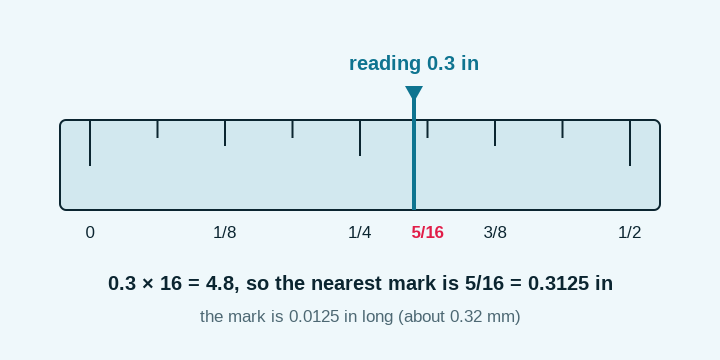
Multiply the reading by the denominator you can cut to, round to the nearest whole number, put that over the denominator, and reduce. The error is the mark minus the reading; positive means the mark is long.
| Reading | Working | Nearest mark | Error |
|---|---|---|---|
| 0.3 in, 1/16 | 0.3 × 16 = 4.8, rounds to 5 | 5/16 = 0.3125 in | +0.0125 in |
| 0.47 in, 1/32 | 0.47 × 32 = 15.04, rounds to 15 | 15/32 = 0.46875 in | −0.00125 in |
| 1.33 in, 1/64 | 0.33 × 64 = 21.12, rounds to 21 | 1 21/64 = 1.328125 in | −0.001875 in |
| 8.5 mm, 1/32 | 8.5 ÷ 25.4 = 0.334646 in; × 32 = 10.71, rounds to 11 | 11/32 = 0.34375 in = 8.73125 mm | +0.23125 mm |
The first row is worth knowing: 0.3 in is not on the tape at all, and the nearest sixteenth is 0.0125 in long, about 0.32 mm. Whether that matters depends on the job; a shelf pin hole usually shrugs it off, a joint that has to close does not, so step up to a finer fraction when the fit is tight. A reading that is already a mark, such as 0.6875 in, comes back as 11/16 with zero error.
To skip the arithmetic, the Inches & mm tab of the fraction calculator takes decimal inches or millimetres and returns the nearest mark at the precision you pick, with its error in inches and millimetres. When the fractions themselves need adding, the guide on adding fractions with unlike denominators shows the LCD route, and the one on dividing fractions covers the rest of the arithmetic.
Common questions
What is 5/8 as a decimal?
5/8 = 0.625. Divide 5 by 8; the division ends after three digits because 8 has only the prime factor 2.
What is 1/3 as a decimal?
1/3 = 0.(3), a 3 repeating forever (0.333…). A rounded 0.3333 is only an approximation, and 0.333 with exactly three places is 333/1000.
How do you turn a repeating decimal into a fraction?
Shift the decimal point by the length of the repeating block, subtract the original to cancel the tail, and divide. For 0.1(6): 100x − 10x = 15, so x = 15/90 = 1/6.
How do you convert decimal inches to the nearest 1/16?
Multiply the decimal by 16, round to a whole number and put it over 16. For 0.3 in: 0.3 × 16 = 4.8, which rounds to 5, so 5/16 in, which is 0.0125 in long.
Which fractions give terminating decimals?
A fraction in lowest terms terminates only if its denominator has no prime factors other than 2 and 5. So 3/8 and 7/10 end, while 5/12 and 1/7 repeat.