Dividing fractions: why keep-change-flip works
6 min read · 9 sections
Dividing fractions answers one question: how many of this size fit into that amount? How many 3/8" spacers fit along a 1 1/2" strip? Four. Keep-change-flip is only the fast way to count them, and once you see why it works you stop flipping the wrong fraction.
Students who learn the rule without the picture get it right on the worksheet and wrong on the shop floor, because they cannot tell whether 7 or 1/7 is a sensible answer. I teach the picture first and the rule second.
Division means "how many fit"
Write the strip and the spacer in the same size and the answer is plain. 1 1/2" is 12/8" and each spacer is 3/8". Twelve eighths divided into groups of three eighths gives 12 ÷ 3 = 4 groups.
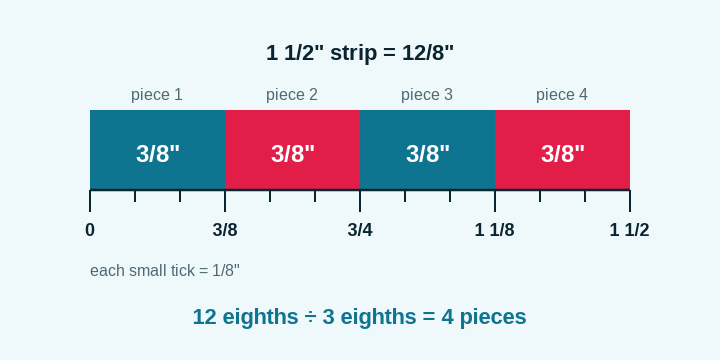
That is the whole idea. With a common denominator, the denominators cancel and you divide the numerators. Keep-change-flip does the same job without making you find the common denominator first.
Keep, change, flip
- Keep the first fraction exactly as it is: 5/6.
- Change the division sign to multiplication.
- Flip the second fraction, the divisor, into its reciprocal: 2/3 becomes 3/2.
- Multiply tops and bottoms: 5/6 × 3/2 = 15/12.
- Reduce by the GCF, 3: 15/12 = 5/4 = 1 1/4.
Multiplication needs no common denominator, which is why this route is short; CalculatorSoup teaches the same multiply-by-the-reciprocal method. My own habit: say "flip the divisor, never the first fraction" out loud until it sticks. Flip the wrong one and 6/5 ÷ 2/3 becomes 5/6 × 2/3 = 5/9, or, if you forget to flip at all, 6/5 × 2/3 = 4/5. The right answer is 6/5 × 3/2 = 9/5.
Why flipping works
Two ways to see it, and either is enough.
Common denominator. 5/6 ÷ 2/3: rename 2/3 as 4/6. Now the question is 5 sixths ÷ 4 sixths = 5 ÷ 4 = 5/4. The keep-change-flip answer was 5/4 too. In general, a/b ÷ c/d = (ad/bd) ÷ (cb/bd) = ad ÷ cb = ad/bc, which is exactly "multiply by d/c".
Making the divisor a 1. Multiply the divisor by its reciprocal and you get 1: 2/3 × 3/2 = 1. Whatever you do to the divisor you must do to the number being divided, so 5/6 ÷ 2/3 becomes (5/6 × 3/2) ÷ 1. Dividing by 1 changes nothing, and what is left is 5/6 × 3/2.
Bigger or smaller? A ten-second check
| Divisor | Effect on the answer | Example |
|---|---|---|
| Less than 1 | Answer is larger than the start | 3/4 ÷ 1/8 = 6 |
| Exactly 1 | Answer is the same | 3/4 ÷ 1 = 3/4 |
| Greater than 1 | Answer is smaller than the start | 3/4 ÷ 2 = 3/8 |
| Zero | No answer: division by zero is undefined | 1/2 ÷ 0, or 1/2 ÷ 0/5 |
Look at that before you write the answer. If a recipe step has you dividing by 1/4 and the answer got smaller, you flipped the wrong thing.
Whole numbers and unit fractions
Grade 5 limits division to unit fractions and whole numbers, taught with pictures (5.NF.B.7). The two cases give you the intuition.
- 1/3 ÷ 4. Cut each third into 4 equal parts, so the whole has 12 parts and each is 1/12. Answer 1/12. By rule: 1/3 × 1/4 = 1/12.
- 4 ÷ 1/5. Each whole holds 5 fifths, so 4 wholes hold 20. By rule: 4/1 × 5/1 = 20.
For any whole number, write it over 1 first: 4 = 4/1, and 3/4 ÷ 2 = 3/4 × 1/2 = 3/8.
Mixed numbers: convert first
Never divide the wholes and the fractions separately. Turn each mixed number into an improper fraction, then keep-change-flip. Take 3 1/2 ÷ 1 3/4: 7/2 ÷ 7/4 = 7/2 × 4/7. The 7s cancel and 4/2 = 2. Check: two pieces of 1 3/4 make 3 1/2. If you want practice, type a few lines into the fraction calculator; it reads mixed numbers, flips the divisor, multiplies, reduces by the GCF and shows each step the way a teacher would mark them.
Word problems, set up and solved
| Question | Setup | Answer |
|---|---|---|
| 3/8" spacers in a 1 1/2" strip | 3/2 ÷ 3/8 = 3/2 × 8/3 | 4 spacers |
| 3/4-cup servings in 4 1/2 cups | 9/2 ÷ 3/4 = 9/2 × 4/3 | 6 servings |
| 2 1/3 cups shared among 3 bowls | 7/3 ÷ 3 = 7/3 × 1/3 | 7/9 cup each |
| 3/4 ft pieces from a 5 1/4 ft board | 21/4 ÷ 3/4 = 21/4 × 4/3 | 7 pieces, before saw kerf |
| 5/8-yard pieces from 3 yards | 3 ÷ 5/8 = 3/1 × 8/5 = 24/5 | 4 4/5: four full pieces and 4/5 of another |
The last row needs care. 24/5 = 4 4/5 means four whole pieces plus 4/5 of another piece, and that leftover is 4/8 yard of cloth, which you cannot cut into a full piece. Ask what the question wants: a count of full pieces is 4, the exact quotient is 4 4/5.
A word on multiplying
Because division turns into multiplication, get multiplication right as well. Multiply tops, multiply bottoms, reduce. Convert mixed numbers first: 2 1/2 × 1 1/3 = 5/2 × 4/3 = 20/6 = 10/3 = 3 1/3.
The tempting wrong answer is 2 1/6, from multiplying the wholes (2 × 1) and the fractions (1/2 × 1/3) and gluing them together. An area model shows what that skips: a 2 1/2 by 1 1/3 rectangle has four parts, 2 × 1 = 2, 2 × 1/3 = 2/3, 1/2 × 1 = 1/2 and 1/2 × 1/3 = 1/6. Add them on the LCD 6: 2 + 4/6 + 3/6 + 1/6 = 2 + 8/6 = 3 1/3. The wholes-times-fractions pieces are the ones that go missing.
Cross-cancelling saves work: in 5/2 × 4/3, the 4 and the 2 share the factor 2, so it becomes 5/1 × 2/3 = 10/3 with no reducing afterwards. "Of" means multiply: 3/5 of 2 1/2 is 3/5 × 5/2 = 3/2 = 1 1/2, and 2/3 of a 3/4-cup recipe is 3/4 × 2/3 = 1/2 cup.
Mistakes I see most
- Flipping the first fraction, or both. Only the divisor flips.
- Flipping a mixed number without converting it. 1 3/4 is 7/4 before it becomes 4/7.
- Cancelling across the division sign before flipping. Change to multiplication and flip first; only then cancel a top against a bottom.
- Forgetting that a whole-number divisor is a fraction over 1, so 3/4 ÷ 2 is 3/8, not 3/2.
- Trying to divide by zero. Any fraction with a 0 numerator equals 0, and dividing by it has no answer.
Next, if the denominators are the part that trips you up, the guide on adding and subtracting fractions with unlike denominators covers the LCD. And to turn a quotient like 24/5 into a decimal with the repeat marked, see the fraction to decimal chart.
Common questions
How do you divide fractions?
Keep the first fraction, change the division sign to multiplication, flip the second fraction into its reciprocal, multiply and reduce. Example: 5/6 ÷ 2/3 = 5/6 × 3/2 = 15/12 = 5/4 = 1 1/4.
Why do you flip the second fraction when dividing?
Dividing by a number is the same as multiplying by its reciprocal, because a number times its reciprocal is 1. With a common denominator you can see it directly: 5/6 ÷ 4/6 = 5 ÷ 4, the same 5/4.
How do you divide mixed numbers?
Convert each mixed number to an improper fraction first, then keep-change-flip. 3 1/2 ÷ 1 3/4 = 7/2 ÷ 7/4 = 7/2 × 4/7 = 2.
How do you divide a fraction by a whole number?
Write the whole number over 1 and flip it: 3/4 ÷ 2 = 3/4 × 1/2 = 3/8. The result is smaller because you are splitting the fraction into more parts.
Can you divide a fraction by zero?
No. Division by zero is undefined, and a fraction like 0/5 equals zero, so dividing by it is undefined too.