Fraction Calculator with Every Step Shown
Type 2 1/2 + 3/4 × 1 1/3 on one line or fill in two fractions, and the fraction calculator answers in lowest terms, as a mixed number and as an exact decimal. Every step is written out the way a teacher marks it, and each fraction is drawn as a bar with a number line for the answer.
Tap ± for a negative fraction. Type 3/4 in one box and it splits itself.
A space between a whole number and a fraction makes a mixed number: 2 1/2. Decimals take a point or a comma, repeating decimals are typed as 0.(3). × and ÷ go before + and −; brackets first.
The answer appears here in lowest terms, as a mixed number and as an exact decimal – with every step and a picture.
Negative numbers are fine on top or below: −18/−24.
Lowest terms with the greatest common factor found step by step.
Point or comma: 0.75 or 0,75. Repeating: 0.(3), 0.1(6) or 0.1666… Scientific: 1e-3.
Write it as 5/12 or 2 3/8. The repeating block gets a bar: 0.41(6) means 0.41666…
Exact both ways: no rounding, repeating digits marked with a bar.
Fractions, mixed numbers or decimals: 7/12, 1 1/3, 0.6.
Which is bigger, by how much, and why – cross products, common denominator and exact decimals.
From a plan, a caliper or a metric drawing to the mark on your tape. 1 inch = 25.4 mm exactly.
The simplest fraction closest to a decimal, found with continued fractions.
The nearest mark, how far off it is in inches and millimetres, and where it sits on the rule.
History (0)
Your last calculations are kept in this browser only.
Enter or Ctrl+Enter = calculate
How to use the fraction calculator
There are two ways in, both under the Calculate tab. Type the whole problem on one line, exactly as it is printed on the worksheet: 2 1/2 + 3/4 × 1 1/3 − 0.5. A whole number, a space and a fraction is one mixed number; a slash with no spaces around it is a fraction bar, so 3/4 is one number; a slash with spaces around it, or right after a closing bracket, divides. ×, * or x multiplies, ÷ or : divides, the word of means times, 50% is a number, and brackets work as you expect, with × and ÷ before + and −. An ambiguous 1/2/3 is refused with a request for brackets instead of a guess. A line may hold up to 200 characters, 30 numbers and 300 digits per number. On the line the answer appears while you type, and Enter calculates.
The other way is the Two fractions button, which is where I start beginners. Tap ± to make a fraction negative, tick Mixed numbers to get a box for the whole number, or type 3/4 or 2 1/2 straight into a box and it splits itself into the right boxes. Both modes use the same engine, so they always agree.
Before any working, the calculator prints how it read your line, for example Read as: (5/2) + (3/4) × (4/3). Check that first: most of the wrong answers I mark come from a problem copied wrong, not from bad arithmetic.
- Lowest terms, as an improper fraction and as a mixed number, with the percent.
- The exact decimal, up to 60 digits, with an overline on the repeating block instead of rounding it away, plus a version rounded to 4 places.
- The steps a teacher wants to see: LCD and multipliers, borrowing, keep-change-flip, the GCF and the Euclid chain behind it.
- A picture: each fraction as a bar cut into its real denominator (negative ones hatched), the bars re-cut into LCD pieces for a sum or difference, and a number line with the result.
Four more tabs simplify a fraction, turn a decimal into a fraction and back, compare two fractions, and round decimal inches or millimetres to the nearest tape-measure mark. Copy puts the whole result on your clipboard, Continue with the answer carries it into the next problem, and the last 20 calculations are kept in your own browser, with an Undo if you clear them. A minus sign can go in front, on top or underneath: −3/4, (−3)/4 and 3/(−4) are the same number, as the Grade 7 standard on rational numbers spells out. The Esc key never wipes your input.
Adding and subtracting fractions: the LCD in three moves
The denominator names the size of the pieces, and you can only add pieces of the same size. That is why 1/2 + 1/3 is not 2/5. The Grade 5 fractions standard asks for exactly this: replace the fractions with equivalent fractions that share a denominator. My classroom rule: find the LCD before you touch a numerator.
- Find the least common denominator, the LCM of the denominators.
- Multiply each fraction, top and bottom, by LCD ÷ its own denominator.
- Add or subtract the numerators, keep the LCD, then reduce.
7/12 − 5/18 → LCD 36 → 21/36 − 10/36 = 11/36
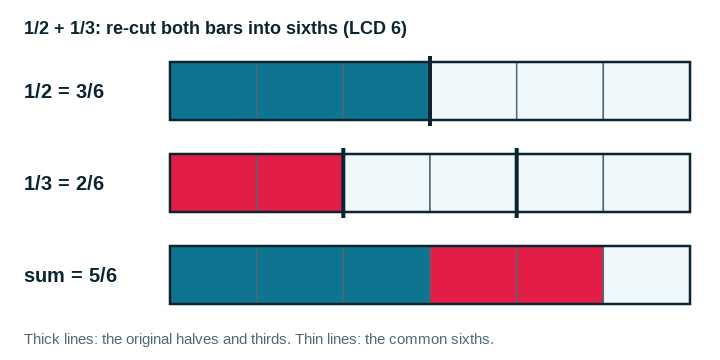
The cross formula (ad + bc)/bd, shown on calculator.net, always works but makes bigger numbers: for 7/12 − 5/18 it uses 216 and lands on 66/216, which you still have to reduce by 6. Three or more fractions are no harder on one line: 1/4 + 1/6 + 1/8 uses LCD 24, not 192, so 6/24 + 4/24 + 3/24 = 13/24 = 0.541(6). The calculator draws the bars of every operand re-cut into LCD pieces whenever the LCD is 48 or less, so you can see why it works. The guide to unlike denominators shows how to find the LCD from prime factors.
Mixed numbers: improper first, borrow when you subtract
Turn each mixed number into an improper fraction before anything else: whole × denominator + numerator, over the same denominator. 2 3/4 = (2 × 4 + 3)/4 = 11/4. The minus in front of a mixed number covers all of it: −2 3/4 is −(2 + 3/4) = −11/4, not −2 + 3/4. So −2 3/4 + 3 5/7 = −11/4 + 26/7 = −77/28 + 104/28 = 27/28. In the boxes, put the minus in front of the whole number or tap ±; a whole number of 2 with a numerator of −3 gets a message asking you where the minus belongs, not a guess.
Subtraction is where homework goes wrong. In 3 1/4 − 1 5/6, rename to twelfths: 3 3/12 − 1 10/12. You cannot take 10/12 from 3/12, so borrow one whole as 12/12: 2 15/12 − 1 10/12 = 1 5/12. The improper route gives the same: 39/12 − 22/12 = 17/12 = 1 5/12. The fraction calculator shows the improper route every time and adds the borrowing line when it applies, so a student can match whichever method the class uses. Another one from a worksheet: 4 1/2 − 2 3/4 → 4 2/4 − 2 3/4 → 3 6/4 − 2 3/4 = 1 3/4.
Multiplying and dividing fractions
Multiplying needs no common denominator: tops times tops, bottoms times bottoms, then reduce. Convert mixed numbers first. 2 1/2 × 1 1/3 = 5/2 × 4/3 = 20/6 = 10/3 = 3 1/3. Multiplying the parts separately (2 × 1 and 1/2 × 1/3) gives 2 1/6, a mistake I see every term. "Of" is multiplication too: 3/5 of 2 1/2 = 3/5 × 5/2 = 3/2 = 1 1/2, and 3/8 of 40 = 15.
To divide, keep the first fraction, change ÷ to ×, and flip the divisor (the method CalculatorSoup also teaches): 5/6 ÷ 2/3 = 5/6 × 3/2 = 15/12 = 5/4 = 1 1/4. Flip the second fraction, never the first. Why the flip works, with pictures and word problems, is in the keep-change-flip guide.
Order of operations matters as soon as there are three terms: 1/2 + 1/3 × 3/4 = 1/2 + 1/4 = 3/4, while (1/2 + 1/3) × 3/4 = 5/6 × 3/4 = 5/8. A two-box calculator never shows you the difference; the one-line mode does, with the reading printed above the steps.
Lowest terms with the GCF
Simplifying means dividing top and bottom by their greatest common factor. For small numbers you can spot it; for anything bigger I use Euclid's algorithm, which the Simplify tab writes out line by line:
84 = 2 × 42 + 0 → GCF 42, so 84/126 = 2/3
For 21/98: 98 = 4 × 21 + 14, 21 = 1 × 14 + 7, 14 = 2 × 7 + 0, so the GCF is 7 and the fraction is 3/14. Two minus signs cancel: −18/−24 = 3/4.
Which fraction is bigger
Cross-multiply and compare. For 5/8 against 3/5: 5 × 5 = 25 and 8 × 3 = 24, so 5/8 is bigger, by exactly 1/40. For 7/12 against 5/8: 7 × 8 = 56 and 12 × 5 = 60, so 7/12 is smaller, by 1/24. Rounded decimals can fool you: to six places, 1/3 and 333333/1000000 both read 0.333333, yet they differ by 1/3000000. The Compare tab gives the exact relation, both fractions over the LCD, the cross products, the difference and both decimals with enough digits to tell them apart. Either side can be a decimal, so 0.75 against 3/4 reports equal.
Fractions and decimals: terminating, repeating and how to type them
A fraction is a division, and long division either stops or settles into a repeating block (standard 7.NS.A.2d). A fraction in lowest terms terminates only when its denominator has no prime factors other than 2 and 5: 1/8 = 0.125, but 5/12 = 0.41(6) because 12 contains a 3. Watch the remainders in 5 ÷ 12: 50 ÷ 12 = 4 r 2, 20 ÷ 12 = 1 r 8, 80 ÷ 12 = 6 r 8. Remainder 8 has come back, so the 6 repeats forever.
Going the other way, count the decimal places, as Math is Fun explains: 0.375 = 375/1000 = 3/8, and 1.0625 = 10625/10000 = 17/16 = 1 1/16. Typed with three places, 0.333 is 333/1000, and the Decimal ↔ fraction tab adds a hint to type 0.(3) if you meant the repeating one; only the repeating 0.333… is 1/3. To enter a repeating decimal, write the period in parentheses (0.1(6)) or square brackets (0.1[6]), or end with dots (0.1666…) and the calculator says which block it read: 0.1666... = 0.1(6). A decimal comma such as 0,75 works too, and so do .5, 5., 1e-3 and a real minus sign. The tab writes out the long division with its remainders for a fraction, and the shift-and-subtract steps for a repeating decimal. For 1.2(36) the trick is to shift by the repeat: 1000x − 10x = 1236.3636… − 12.3636… = 1224, so x = 1224/990 = 68/55.
| Fraction | Exact decimal | Rounded to 4 decimal places | Percent (to 2 places) |
|---|---|---|---|
| 1/2 | 0.5 | 0.5000 | 50% |
| 1/4 | 0.25 | 0.2500 | 25% |
| 3/4 | 0.75 | 0.7500 | 75% |
| 1/8 | 0.125 | 0.1250 | 12.5% |
| 3/8 | 0.375 | 0.3750 | 37.5% |
| 5/8 | 0.625 | 0.6250 | 62.5% |
| 7/8 | 0.875 | 0.8750 | 87.5% |
| 1/3 | 0.(3) | 0.3333 | 33.33% |
| 2/3 | 0.(6) | 0.6667 | 66.67% |
| 1/6 | 0.1(6) | 0.1667 | 16.67% |
| 5/6 | 0.8(3) | 0.8333 | 83.33% |
| 1/7 | 0.(142857) | 0.1429 | 14.29% |
| 1/9 | 0.(1) | 0.1111 | 11.11% |
| 1/12 | 0.08(3) | 0.0833 | 8.33% |
The full chart, every reduced fraction up to twelfths and sixteenths plus all sixty-fourths of an inch in millimetres, is in the fraction to decimal chart.
Fractions in the workshop and the kitchen
My tape measure reads in sixteenths, and plans rarely do. Adding two measurements: 5 3/8″ + 2 11/16″ = 86/16 + 43/16 = 129/16 = 8 1/16″. A cut list on one line: from a 96″ board, three shelves at 23 5/8″ with a 1/8″ saw kerf per cut leave 96 − 3 × 23 5/8 − 3 × 1/8 = 99/4 = 24 3/4″. How many 3/8″ spacers come out of 1 1/2″? 3/2 ÷ 3/8 = 4.
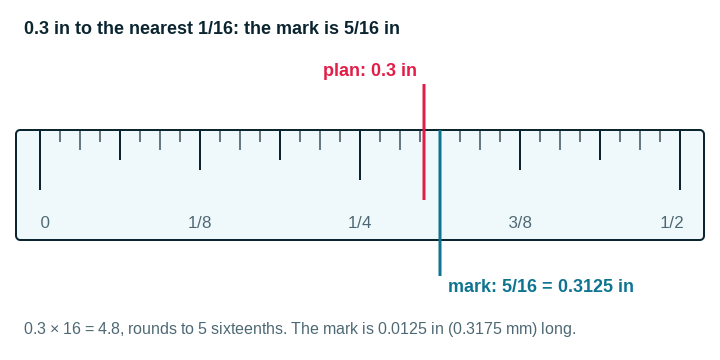
To find the nearest mark, multiply the decimal by the denominator, round to a whole number and put it back over the denominator. A plan says 0.47″: 0.47 × 32 = 15.04, so the mark is 15/32″ (0.46875″, 0.00125″ short). For 1.33″ at sixty-fourths, 1.33 × 64 = 85.12, so 85/64 = 1 21/64″. Millimetres go through 25.4 mm per inch exactly: 8.5 mm is about 0.3346″, and the nearest 1/32 is 11/32″ = 8.73125 mm, 0.23125 mm long. The Inches & mm tab does this at any precision from 1/2 to 1/64. It takes inches, millimetres or a typed measurement such as 23 5/8″, shows the error in inches and in millimetres and whether the mark runs long or short, rounds a reading exactly halfway up to the larger mark, and lists the nearest mark at every precision in one table. A second mode finds the closest fraction with a denominator up to a limit you choose: 3.14159 gives 355/113 up to 1000 and 311/99 up to 100.
In the kitchen, one and a half batches of a recipe that takes 3/4 cup need 3/4 × 1 1/2 = 9/8 = 1 1/8 cups; two thirds of the recipe takes 3/4 × 2/3 = 1/2 cup; and 2 1/3 cups split three ways is 7/9 cup each. No measuring cup shows 7/9, so I measure 3/4 cup and add a little: the gap is 1/36 cup.
Mistakes I mark most often
- Adding the denominators: 1/2 + 1/3 written as 2/5 instead of 5/6.
- Using the product of the denominators and then not reducing: 66/216 left on the page instead of 11/36.
- Subtracting mixed numbers without borrowing, which turns 3 1/4 − 1 5/6 into nonsense; the answer is 1 5/12.
- Multiplying mixed numbers part by part: 2 1/2 × 1 1/3 is 3 1/3, not 2 1/6.
- Flipping the first fraction in a division instead of the divisor.
- Treating 0.333 as 1/3; it is 333/1000.
- Working a chain left to right: 1/2 + 1/3 × 3/4 is 3/4, not 5/8.
- Reading −2 3/4 as −2 + 3/4; it means −11/4.
Whole numbers under the hood: why nothing gets rounded
Every number is stored as a pair of integers of any length, never as a floating-point decimal. That is why 0.1 + 0.2 comes out as exactly 3/10, and a 30-digit numerator keeps all of its digits. After each step the result is normalised: positive denominator, numerator and denominator with GCF 1, zero written as 0/1. Decimals are produced by long division that tracks remainders, so a repeating block is found, not guessed. The only rounding is the separate 4-place line and the Inches & mm tab, where you choose the precision and the error is shown; a decimal longer than 60 digits is cut there and ends with “…”. A zero denominator or a division by zero gets a plain message (“Denominator can't be zero”, “Can't divide by zero”) instead of a number. Everything runs in your browser; nothing you type is sent anywhere, and the history lives only in your own browser storage.
Before release the fraction calculator is run against control cases worked out separately with Python's exact fractions module, in English and in German. The main ones:
| Input | Expected result |
|---|---|
| 1/2 + 1/3 | 5/6 = 0.8(3) |
| 7/12 − 5/18 | 11/36 = 0.30(5), LCD 36 (×3, ×2) |
| −2 3/4 + 3 5/7 | 27/28 = 0.96(428571) |
| 3 1/4 − 1 5/6 | 17/12 = 1 5/12, borrowing 2 15/12 − 1 10/12 |
| 2 1/2 × 1 1/3 | 10/3 = 3 1/3 |
| 5/6 ÷ 2/3 | 5/4 = 1.25 |
| 1/2 + 1/3 × 3/4 | 3/4 |
| (1/2 + 1/3) × 3/4 | 5/8 |
| 1/4 + 1/6 + 1/8 | 13/24 = 0.541(6) |
| 96 − 3 × 23 5/8 − 3 × 1/8 | 24 3/4 |
| Boxes: −3/4 + 1/4, whole 2 + 1/3 | −1/2; 7/3 = 2 1/3 |
| Simplify 84/126; 21/98; −18/−24 | 2/3 (GCF 42); 3/14; 3/4 |
| Decimal to fraction: 0.375; 1.0625; 0,75; 0.333 | 3/8; 1 1/16; 3/4; 333/1000 |
| Repeating to fraction: 0.(3); 0.1(6); 1.2(36); 0.(9); 0.41(6) | 1/3; 1/6; 68/55; 1; 5/12 |
| Fraction to decimal: 5/12; 1/7; 22/7; 3/11; 1/8 | 0.41(6); 0.(142857); 3.(142857); 0.(27); 0.125 |
| 1 followed by 30 zeros, over 1 | all 31 digits, not 1e+30 |
| Compare 5/8 and 3/5 | 5/8 is greater (25 > 24), difference 1/40 |
| Compare 1/3 and 333333/1000000 | 1/3 is greater, difference 1/3000000 |
| Compare 7/12 and 5/8 | 7/12 is less (56 < 60), difference −1/24 |
| 0.3 in, nearest 1/16 | 5/16 in (+0.0125 in) |
| 1.33 in, nearest 1/64 | 1 21/64 in (−0.001875 in) |
| 0.6875 in, nearest 1/16 | 11/16 in, exact |
| 8.5 mm, nearest 1/32 | 11/32 in = 8.73125 mm (+0.23125 mm) |
| 3.14159, denominator at most 1000; at most 100 | 355/113; 311/99 |
| 1/2 ÷ 0 | “Can't divide by zero”, no result |
Common questions
How do you add fractions with different denominators?
Rename them over the least common denominator, add the numerators and reduce. For 1/2 + 1/3 the LCD is 6, so 3/6 + 2/6 = 5/6.
How do you subtract mixed numbers with borrowing?
Rename the fractional parts over the LCD; if the first is smaller, take one whole from the first number as LCD/LCD. 3 1/4 − 1 5/6 becomes 2 15/12 − 1 10/12 = 1 5/12.
How do you turn a repeating decimal into a fraction?
Multiply by powers of ten so the repeating parts line up, subtract and reduce. For 0.1(6), 100x − 10x = 16.666… − 1.666… = 15, so x = 15/90 = 1/6.
What is 0.375 as a fraction?
0.375 = 375/1000, and dividing by the GCF 125 gives 3/8. In the same way 0.3125 = 5/16 and 0.6875 = 11/16.
How do you convert decimal inches to the nearest 1/16?
Multiply by 16, round to the nearest whole number and write it over 16, reducing if you can. 0.3″ × 16 = 4.8, so the mark is 5/16″, 0.0125″ longer than the plan.
Can a fraction have a negative denominator?
Yes, but it means the same as a minus in front or on top: 3/(−4) = (−3)/4 = −3/4. The usual habit is to keep the denominator positive, and the calculator moves the minus to the top for you.
Guides
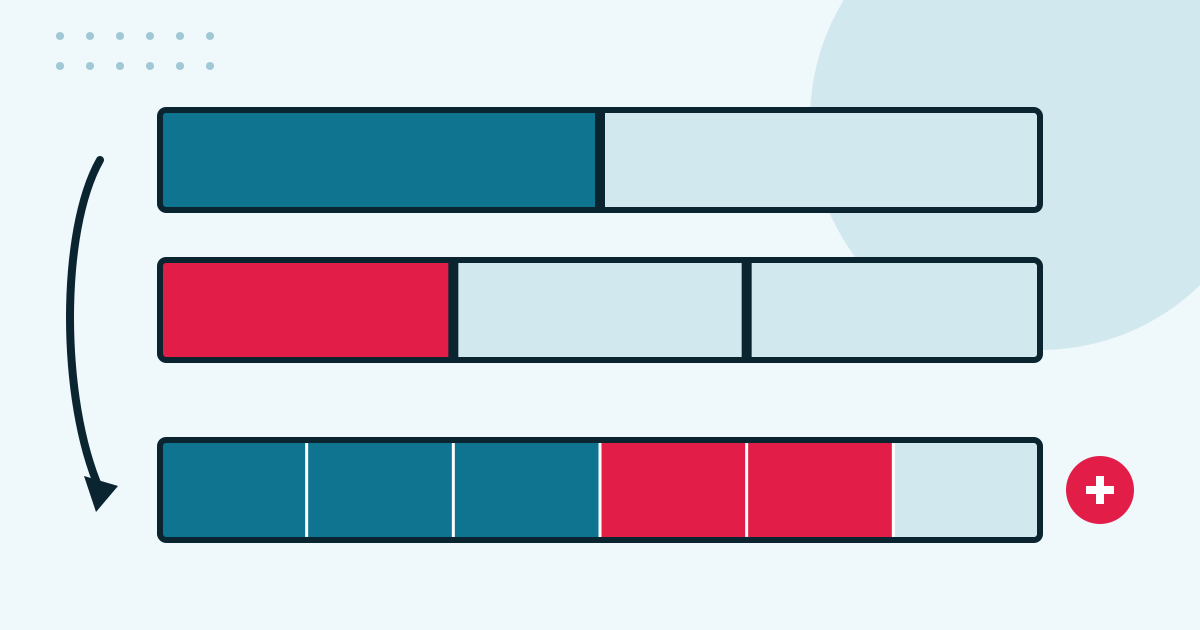 Adding and subtracting fractions with unlike denominatorsWhy 1/2 + 1/3 is not 2/5, how to find the LCD, and how to borrow in mixed-number subtraction, with worked examples.7 min read
 Dividing fractions: why keep-change-flip worksCount how many 3/8" spacers fit in 1 1/2", then see why keep-change-flip works, with mixed numbers and word problems.6 min read
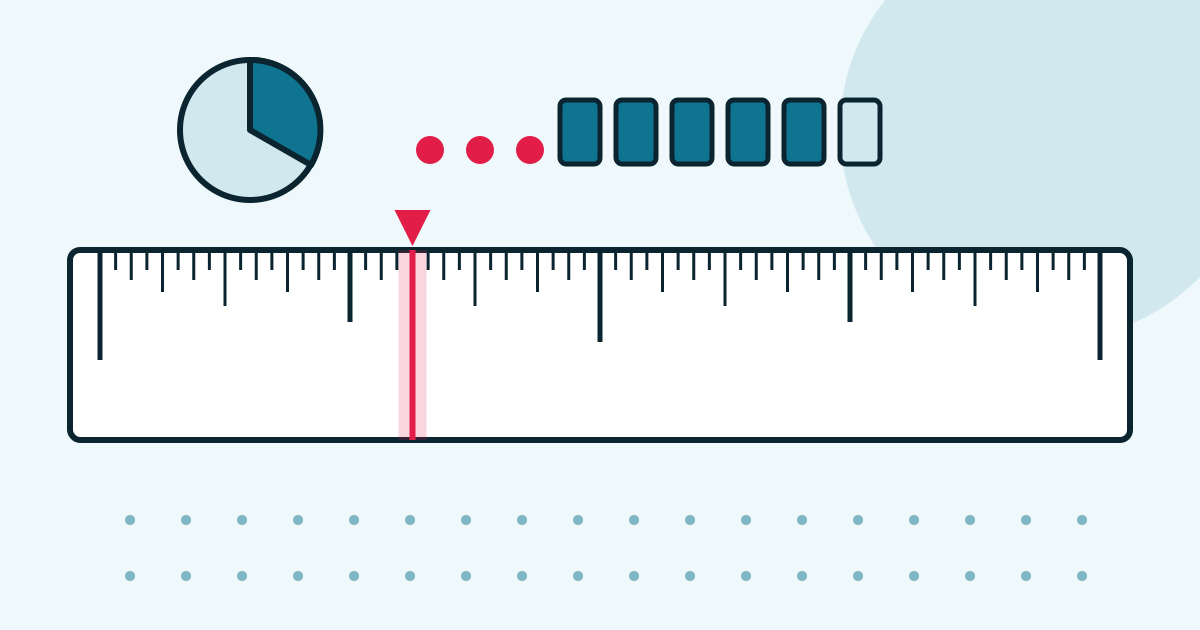 Fraction to decimal chart: halves to sixty-fourthsCharts from halves to sixty-fourths with repeating decimals marked, inch fractions in mm, and how to convert any value by hand.7 min read
Updated